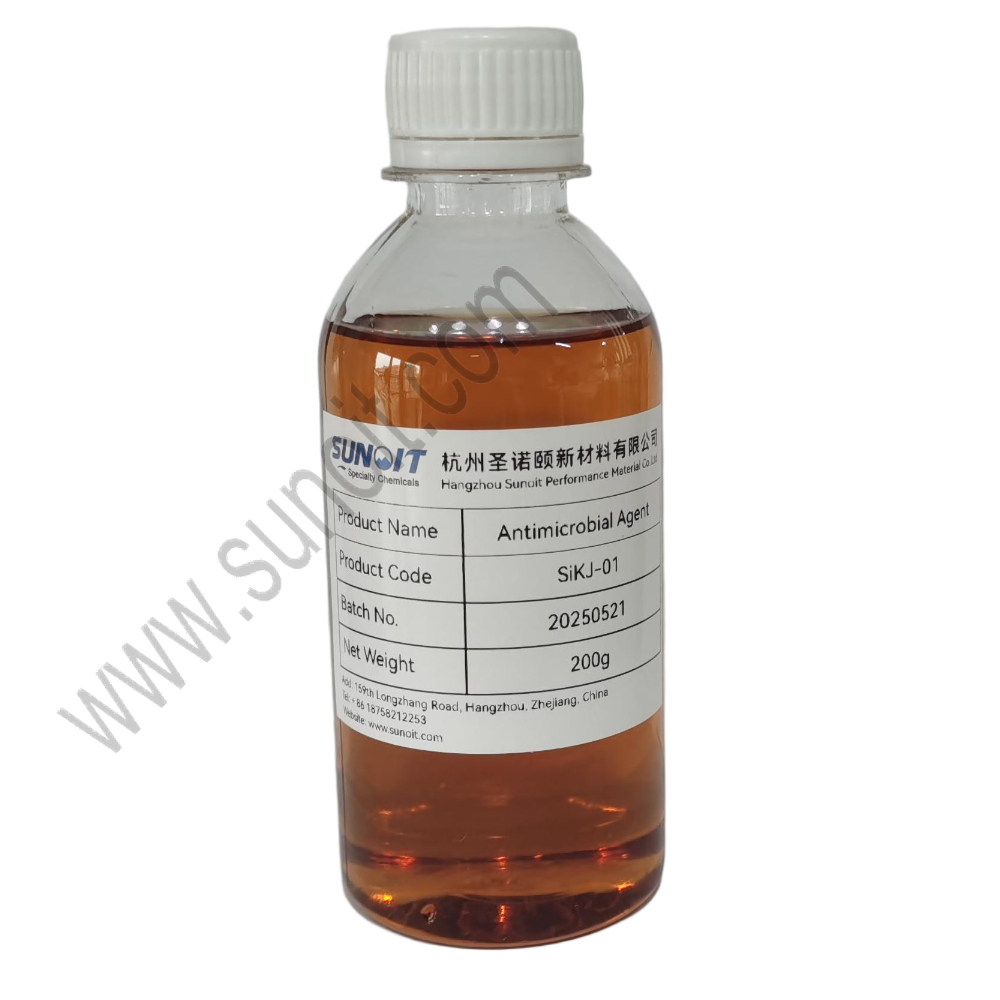
SiKJ-1860 is 60% active silicone quaternary ammonium salt which act as an general use anti-microbial agent for all kinds of natural and synthetic fibers.
Description
SiKJ-1860 is 60% active silicone quaternary ammonium salt which act as an general use anti-microbial agent for all kinds of natural and synthetic fibers.
Features
• Excellent antimicrobial activity in finished product
• Laundry-resistant, providing durable odor control and fabric protection
• Environmentally friendly and safe, non-irritating to skin
Product data
Items | Value |
Appearance | Light yellow or amber transparent liquid |
Solvent | Isopropyl alcohol |
Specific gravity, 25℃ | 0.90 - 1.00 |
Active content,% | 60 |
Viscosity, 25℃, cSt | 5 |
pH | 6.0-7.0 (2% solution) |
Ionicity | Cationic |
Notes: these data are for reference only and should not be used as preparation specifications.
Application
SiKJ 1860 is effective against Gram-positive bacteria, Gram-negative bacteria, fungi, algae, and yeasts. By inhibiting the growth of bacteria and mold, it provides a fresh, hygienic feel and resists odor generation. SiKJ 1860 can be used for antimicrobial finishing on various textiles, including:
• Natural fibers: cotton, linen, wool, silk
• Synthetic fibers: polyester, nylon, acrylic, vinylon, spandex
• Blended fabrics: cotton/polyester, wool/polyester, cotton/acrylic, etc.
How to use
SiKJ 1860 can be applied to fibers and textiles through padding, exhaust, spraying, or roller coating.
• Depending on the antimicrobial performance required, the dosage of SiKJ 1860 is approximately 0.25% - 3% (owf, on weight of fabric).
• It is recommended to dilute with warm water (25°C to 50°C) and stir thoroughly to activate the product, preparing a working solution of 2% - 5% SiKJ 1860.
• SiKJ 1860 may solidify at a low temperature, warm to melt and stir before dilution and use.
• SiKJ 1860 is incompatible with anionic surfactants. For other types of auxiliaries, compatibility testing is recommended before use.
• To ensure durable antimicrobial effects, proper baking (curing) is required after application.
Typical Process Example (for polyester/cotton or blended woven fabrics)
• Preparation of working solution: Typical application dosage of SiKJ 1860 is 2% - 3% of fabric dry weight. Add the concentrate to deionized water at 25°C - 50°C and stir to dissolve, preparing a 2% - 3% working solution. The pH of the working solution should be adjusted to 6.0 - 7.0.
• Add the diluted and activated working solution to the final padding bath. The actual bath concentration depends on the fabric's wet pick-up (wpu%).
• If mixing with other finishing auxiliaries (e.g., softeners, moisture-wicking agents), mix thoroughly before use.
• Pad the fabric.
• Drying and curing: Cure at 150°C - 160°C for 3-5 minutes (depending on fabric type).
Rapid Wash Resistance Test (Bromophenol Blue Indicator Method)
Drop a few drops of dilute bromophenol blue indicator onto the antimicrobial finished fabric. Dry at 110°C, then launder several times. Observe whether the blue color remains on the fabric:
- Blue color present: antimicrobial agent is still effectively bound.
- Blue color disappeared: antimicrobial agent has been washed off.
Contact: Kobe.Mao
Phone: +86 18758212253
E-mail: info@sunoit.com
Whatsapp: + 86 18758212253
Add: 159th Longzhang Road, Hangzhou, Zhejiang Province, China